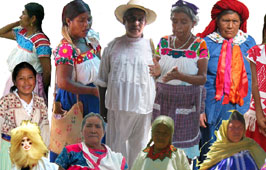
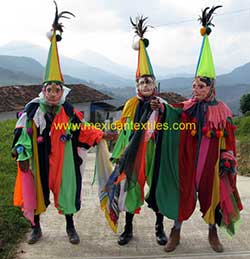
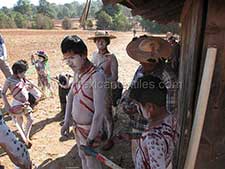
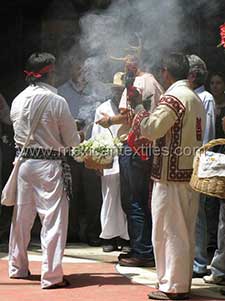
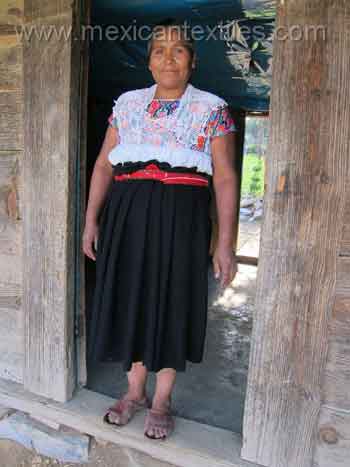
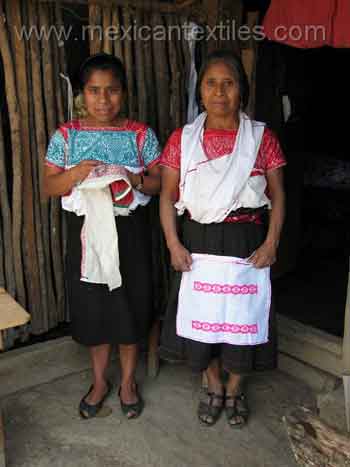
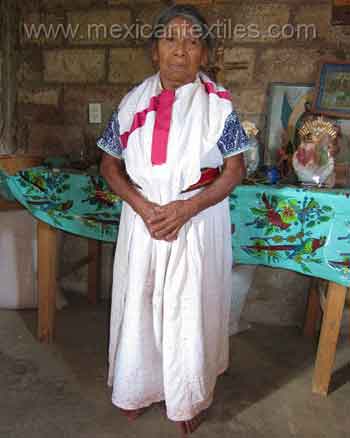
For every example here there are a thousand more in the field.
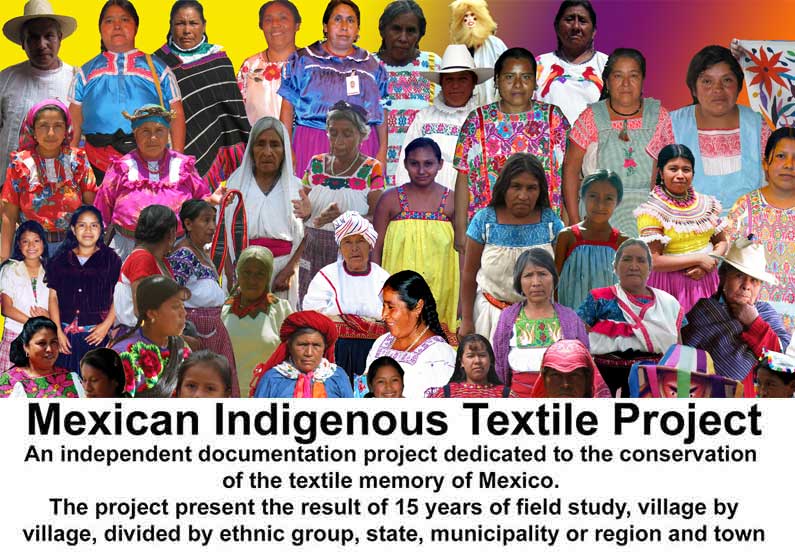
Mexican textiles have existed for more than 7000 years, but now in many villages’ traditional embroidered blouses, back strap woven huipiles, loomed quechquemitls and belts are worn only by the grandmothers. Mexico's indigenous textile culture is in danger of extinction. The embroidered designs on blouses and huipiles are particular to specific towns and ethnic groups. The textiles identifies the groups and villages that various textiles come from, sometimes it is ribbons or the way they comb their hair. The 7000 years old time line ends with these grandmothers.
These wonderful colorful textiles link the indigenous peoples with culture and cosmovison of their native culture. As grandmothers, daughters and granddaughters sit with other family members to make the garments they discuss style, techniques but something else more important, behaviors, customs of marriage, child birth, the herbs used for healing, how to make a tamales etc. These links are lost staring into the one eyed Cyclops that is the TV or washing floors in the DF.
When Cortez came to Mexico almost all the women wove cloth for garments and ceremonial use. It is natural that these talents gradually disappeared in the face of European machine made goods and now over time the Asian dynamo and its inexpensive clothing. However it is not natural that the long cultural heritage of Mexico indigenous textiles be abandoned to the scrap heap of history, not without some sort of attempt to conserve this incredible rich cultural treasure.
The Spanish in all their colonial institution drilled into the population that to be an Indian was the bottom of the heap. These conquered people have been passed down from the Spanish to the Mestizo population that now rules Mexico. This mestizo population has continued the discrimination of the Spanish towards the “indios” , It is no wonder that most Indians want to leave that part of them selves behind.
Below are some of the principal factors leading to the decline of the use and manufacture of indigenous textiles in Mexico. They are personal observations based on an intensive 6 year study of the pueblos de Mexico.
1. Globalization
Around the world indigenous cultures are under pressure from the forces of modernization and globalization. In Mexico, years of government neglect and a persistent racism have created an economic desperation which has forced generations of men and women to flee the poverty of their communities. These indigenous people immigrate to the big cities of Mexico and the USA. Traditional dress marks them as indigenous, and in a society where being an “indian” puts you at the bottom of the social ladder, that is not good. So for decades, as people leave the communities, they leave behind their ancestral knowledge of how to weave, embroidered and the social identity that the Mexican indigenous textiles and language provide.

Road building has created a really fast way for the indigenous population to abandon their villages for a better life just about anywhere else.
With the introduction of the internet TV and printed material, into these small communities the spread of western fashion has been accelerated.
Immigration –
A steady increase in the indigenous population and the child survival rate has led to increased migration from the villages to the cities in Mexico and the US.
Recently in the Sierra Zongolica the operator of a ECO tourism center with support from the CDI and other government institution left to go the US to pick oranges for a year.
In every village, without exception, people migrate to the US out of desperation, true they sometimes send money back to support the town festival but they return with ideas of modernization. Traditional dress is viewed as a marker of the old ways. They almost never wear traditional clothing again and in some cases there wives give it up also to be modern.
In Santiago Mexquitlan this woman was photographed in traditional dress in January 2005 , when returning to deliver her photos 6 months later , she no longer was wearing her costume ( uniform) . When asked why, she said that she worked in Toluca and no one wore costume there and if she wore her costume, they ( the mestizos) would stare and laugh at her. 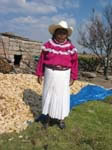
2. Rebellion of youth
Who are the Cholos , no it is not another indigenous group, well not a historical one, they are young men and women who have left the village to work either in Mexico City or the US and return dressed as gang members who resent or hate their culture. They influence the younger kids by bad example. Recently in some Totonacan towns in the Sierra Norte of Mexico I obeservfed a group of 20, some with spiked hair, dressed in black with pierced tongues and noses, they seem like they landed there from another planet. A village elder said to me that they come home and act badly and “se sienten hombre” which means they feel like men.
Some years ago in Santa Anna Hueytlalpan, Hidalgo I noticed a black wrap skirt hanging on a cloths line. Inside the compound there were young women washing and chattering, we struck up a conversation. The conversation gradually drifted to the black wrap skirt, it turned out to be their grandmothers. I asked if they had one, with a tone of ridicule in their voices they said they would never wear that since it made them look like grandmothers.
In the embroidery town of Zoatecpan, Xochitlan de VS, Puebla I was shocked to see the rapid transition among the younger women. Only 4 years ago it seemed the 80% of the people in town wore a traditional blouse. This Christmas at the town’s festival the number was down to 50% or less.
The daughter of the head of the textile co-operative was wearing modern clothing, why I asked. She replied that she didn’t like it. On the floor in the living room was a magazine of TV stars. 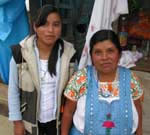
3. Media
On any given day there is not a word about indigenous communities or their customs in main stream media. TV is almost entirely filled with reasons not to wear indigenous clothing as can be seen on almost all Telenovelas, Just imagine a woman , who after 35 years gets a TV and watches “Rubi” all they can think about is how ugly, fat, poor and forgotten they are and how much they want to be someone else. .
Outside of Channel 22 and 11 both public educational channels there is not a word about indigenous people, almost nothing about indigenous dress and sometime the only visual hint that there are 15 million indigenous people in Mexico is a vase or some sort of handicraft as a prop on the studio set.
In the Casas de Cultural we can find a smattering of presentations dedicated to indigenous peoples and there crafts and the Museum of Arte Popular does a reasonable job of presenting these forgotten people.
As with many other social and cultural events in Mexico the presence of these shows that occur all over Mexico City and beyond are under reported. Some times take the metro and get off at every stop to see what notices have been posted.
5 Garment substitutions based on costs
– In the early 1970 during the heyday of hippie Peasant wear fad, I exported 10000 garments a month. These were gathered from all over Mexico and shipped them to Nuevo Laredo where my friend Caesar would consolidate and drive the goods into the US. One day I arrived to do my customs entry and he had on the most stunning Guayabera shirt. Since I was buying Gauyabera shirts wholesale at $15 from the Yucatan it peaked my interest.
“Hey Caesar , where did you get that amazing shirt. “
He replied “got it in Laredo for 7 dollars, it is made in Taiwan”
I will never forget that and what it meant for textiles from Mexico, this was 1972.
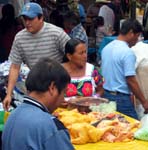
In the town of Huehuetla Hidalgo , Maria a Tepehua weaver makes 4 quechquemitls a year they sell for 1000 pesos. That is out of the reach of all but a few people in the town. Compounding the issue she is the only weaver left that can weave a quechquemitl.
A recent survey of Tepehua women who wear the quechquemitl had the count at 80 women, by the time I saw the survey 2 had died…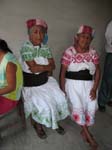
In the Totonacan towns along the Trans Serrano highway, an embroidered blouse cost $70- 150 pesos, the Totonaca belt cost $600 and the skirt and slip cost 250 . In the Tuesday market 2 blouses, a skirt and a sweater made in Asia cost 250 pesos. I have seen jeans for as low as 70 pesos.
6. Loss of heritage skills like weaving and embroidery.
In the town of Huehuetla Hidalgo , Maria a Tepehua weaver makes 4 quechquemitls a year they sell for 1000 pesos. That is out of the reach of all but a few people in the town. Compounding the issue she is the only weaver left that can weave a quechquemitl .
Marias daughters wear western cloths, spea Tephua and do not know how the weave the quechquemitl. Maria says that it is to much work for them to weave.
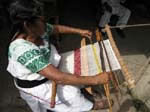
In San Miguel Ameyalco , Lema , about 30 minutes from the DF , there are a small number of weaver that use ancestral skill to produce no indigenous crafts for sale. Some years ago the town was famous for ayates used for agricultural purposes. When I first met Maria de Jesus she lamented the she knew 750 designs on the back strap loom but her daught was taught in some handicraft scool how to make pictures from colored straw. So when Maria passes away those designs will pass away also 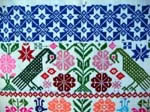
In the Mixtec weaving communities along the coast, traditional costume is confined to the oldest generation. Weaving skill have been past on and there is a large number of women dedicated to weaving , using traditional methods but not no many traditional garments. There are also garments made to look like traditional but were never worn or used before.
Tamazulapan Mixe – there has been a rapid decline in the peop0le wearing the white huipil and the dark blue wrap skirt, this in turn as reduced the number of weavers who make these items. Some have turned to making rebosos for resale.
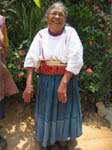 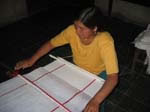
Quality degradation – When I lived in Ocotlan De Morelos Oaxaca in the 1970 many Zapotec women work the famous San Antonio wedding dress, but not as a dress it was used as an undershirt. During the late 1960’s and through the 1970’s the style of embroidery was made into a dress. The Zapotec embroiderers of the day had a polish skill and the dress actually had some cultural meaning. Today the sad quality of these dresses leave a person that has seen and knows the classic blouse or dress when only a glimmer of its past glory. They continue to sell but the younger generation no longer uses them. From time to time an older woman will make one for her daughter to wear but the classics are not history.
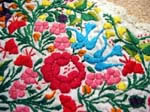
The quechquemitls from Chachahuantla, Puebla, were originally a hand knotted lace, they then moved to a commercial material with heavy machine embroidery, recently the women have been switching over to a solid store bought gauze quechquemitl.
Changes in materials
It is almost impossible to find 100% cotton material in any indigenous blouse and even in traditional huipil synthetic fiber is slipping in. There are a few reasons for this cotton cost more than cotton / synthetic blends and colors are faster in the synthetic yarns.
The yarns can also be embroidered 2 or 3 x faster than the traditional cotton thread and this makes the blouses easier to commercialize.
In many cases the quechquemitl is a key indicator of how things are going , among the Totonacan women of the Sierra Norte of Puebla , hand woven or knotted quechquemitls have been entirely replace with store bought lace. Only 10 years ago the quechquemitls of store bough lace had embroidery on them .
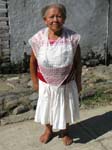
In the municipality of Zongozotla I noticed a fashion transformation happening, instead of the white store bought lace some women were using colored lace for their quechquemitls. The thing is that the white lace was a direct descendent of the back strap woven cotton quechquemitl which is also white. The quechquemitl made from colored machine made lace losses that connection.
The church –
In the Sierra Zongolica of Veracruz, road building has help people to escape the poverty of the region, recently in a village outside of Xoxocotla I found no women wearing traditional costume, apparently the church had been telling the women for years that it made them look Indian.
Summary – The movement of indigenous people towards the main stream of Mexican Society is well underway, the education system, government programs, road building, TV and immigration all play their part. The long history of discrimination and marginalization plays a large part in the desire NOT to be viewed as indigenous by the younger generation. These young people relate more to modernism as an escape, than to ancestral duties and customs.
So they gladly change from poor Indians to poor Mexicans, they do this by not speaking the ancestral language, not dressing in indigenous specific ways and denying thier heritage.
Bob Freund
www.mexicantextiles.com
|